
A Penn State research project is examining a potential way for dairy farmers to reduce their reliance on herbicides: making the corn crop itself more competitive against weeds.
The research, led by Plant Science Ph.D. student Noelle Connors, focuses on short-stature corn hybrids and planting strategies that encourage the crop to form a dense canopy. The goal is to determine if stronger crop competition can suppress weeds while maintaining corn silage yields and forage quality. The work is particularly relevant to Pennsylvania dairy farms, where corn silage is often followed by a winter small-grain silage crop. Keeping weeds under control in these intensive cropping systems commonly depends on herbicides, creating interest in additional approaches that can reduce chemical inputs without sacrificing production.
Shorter Corn May Have an Advantage
Traditional corn hybrids can become more susceptible to lodging when planted at very high populations. Lodging occurs when plants bend or fall over, potentially making harvest more difficult and reducing crop performance.
Short-stature hybrids are designed to remain more upright at higher planting densities. That characteristic gives researchers an opportunity to test a strategy that would be difficult to implement with some conventional hybrids: planting more plants in less space.
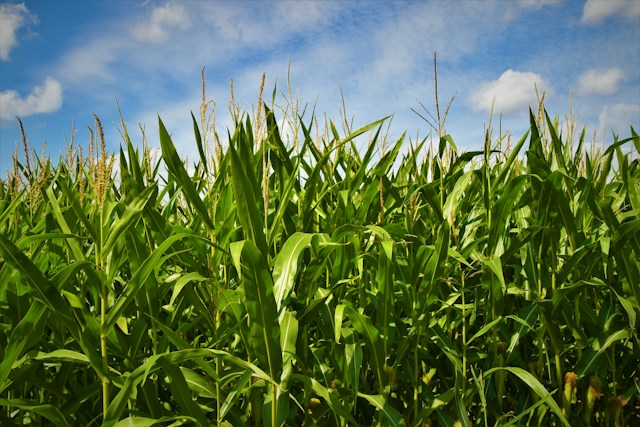
The theory is straightforward. A dense corn stand can close its canopy more quickly, reducing the amount of sunlight reaching the soil surface. Weeds that emerge beneath a dense canopy have less access to light and may produce less biomass and fewer seeds.
Previous research has suggested that narrower rows and higher plant populations can improve this competitive effect. Connors’ work is testing how well that concept translates to newer short-stature hybrids under Pennsylvania growing conditions.
Researchers Tested Different Planting Strategies
The study compared short-stature and conventional corn under several planting arrangements. Researchers looked at higher plant populations and 15-inch rows and compared them with more conventional 30-inch spacing.
The experiments also introduced three weed species that can create significant management problems: burcucumber, common cocklebur and Palmer amaranth. The weeds were introduced at different points during crop development to examine how their emergence timing affected competition with corn.
Researchers measured more than just the amount of weed growth. They also tracked weed seed production, corn silage yield and forage quality. Measurements of light penetration, soil moisture and soil temperature provided additional information about how different crop arrangements changed conditions within the field.
Dense Corn Stands Produced Stronger Weed Suppression
The research found that higher plant populations generally increased silage yields, while differences in forage quality were relatively small. Planting arrangement also mattered for weed control. The combination of narrow rows and high plant populations produced the strongest suppression in the trials.
The timing of weed emergence was another important factor. Weeds that emerged later in the season generally produced substantially less biomass and fewer seeds than weeds that emerged earlier, indicating that the competitive advantage provided by an established corn canopy can become more pronounced as the season progresses.
Under some combinations of weed species, emergence timing and environmental conditions, researchers reported reductions in weed biomass and seed production of as much as 99%. That figure represents the strongest results observed under particular experimental conditions, rather than a guaranteed reduction that farmers should expect in every field.
Weed Seed Production Matters
Reducing the amount of weed growth in a field is useful, but limiting seed production could have an even longer-term effect.
A weed that survives long enough to produce seed can add to the seedbank in the soil, potentially creating management problems in subsequent crops. Palmer amaranth is one example of a particularly troublesome weed because populations can develop resistance to herbicides, making chemical control more difficult.
Penn State’s weed-management guidance notes that herbicide options and their effectiveness can be limited by resistance. The university’s 2026 weed-management updates also emphasize the need for different control strategies and effective herbicide modes of action as resistant weed populations become more challenging.
A planting system that prevents weeds from producing as much seed could therefore contribute to longer-term weed management, even if it does not eliminate the need for herbicides.

The Approach Does Not Eliminate Herbicides
The research should not be interpreted as showing that farmers can simply stop using herbicides. Penn State continues to recommend careful attention to herbicide timing and weed size because some weeds can become difficult to control once they grow beyond effective treatment stages. Early-season management remains particularly important for annual grasses and other weeds that can compete with young corn before the crop develops a strong canopy.
The potential value of the short-stature corn strategy is instead its ability to add another layer of weed control. Stronger crop competition could reduce the amount of weed growth that needs to be addressed chemically, potentially allowing farmers to use an integrated approach rather than depending on a single control method.
That distinction is important because weed management becomes more difficult when one strategy is used repeatedly. Combining crop competition, crop rotation, scouting and carefully selected herbicides can provide more options when individual weed-control methods become less effective.
A Good Fit for Pennsylvania Dairy Systems
The research is particularly relevant to dairy operations because of the way many Pennsylvania farms grow forage. A common system involves harvesting corn silage and then establishing a winter small-grain silage crop. That tight rotation leaves limited time between crops and creates repeated opportunities for weeds to establish themselves.
Connors’ research is being conducted within a no-till, double-cropping system using dairy manure as the primary nitrogen source. The research therefore examines the corn strategy within a production system that resembles practices already used on some dairy farms rather than treating weed suppression as an isolated issue.
Reducing herbicide use could potentially lower input costs and decrease the amount of chemical entering the farm system. The financial effect, however, would depend on seed costs, planting rates, equipment requirements, weed pressure and the extent to which herbicide applications could actually be reduced.
Several Questions Still Need Answers
The early findings are promising, but additional research is needed before the approach can be considered a broadly applicable replacement for conventional weed-control programs.
The reported reductions in weed biomass and seed production varied according to weed species, emergence timing and environmental conditions. That means results from controlled research plots may not translate directly to every Pennsylvania farm.
There are also practical questions surrounding the cost of higher seeding rates and narrower rows. Farmers would need to determine if potential savings from reduced herbicide use and improved crop competition offset additional seed and equipment costs.
Weather could also influence the results. Crop growth, canopy development and weed emergence are strongly affected by temperature, rainfall and soil conditions. A planting strategy that performs well during one growing season may produce different results under another set of conditions.
Finally, the research needs to demonstrate that weed suppression can be maintained over multiple seasons without creating unintended effects on yields, soil conditions or subsequent crops.

Crop Competition Could Become Another Weed-Control Tool
The Penn State research points toward a broader approach to weed management in which the crop itself becomes part of the control strategy.
Short-stature corn gives researchers more flexibility to experiment with higher plant populations, while narrow rows can help the crop establish a canopy that limits light available to weeds. The early findings indicate that those factors can work together to reduce weed growth and seed production while maintaining corn silage production.
The significance of the work may ultimately extend beyond reducing a single herbicide application. If crop competition can consistently suppress troublesome weeds, it could become another component of integrated weed management and help farmers diversify the tools they use to protect yields.
For Pennsylvania dairy producers, the next step is determining how those research results perform under commercial farm conditions, across different seasons and against the wide range of weed pressures found in working fields.