


The U.S. House of Representatives has approved bipartisan legislation intended to prevent households and small businesses from absorbing the cost of electricity infrastructure needed to support large data centers.
The Ratepayer Protection Act, formally known as H.R. 9340, passed the House on September 16 by a vote of 417-3. The legislation would establish a federal standard for state utility regulators to consider when determining how the costs of new power generation, transmission and distribution upgrades should be allocated when large electricity users, including data centers, connect to the grid.
The measure was introduced by Reps. Gabe Evans, a Colorado Republican, and Kathy Castor, a Democrat from Florida, and attracted support from lawmakers in both parties. Its passage represents one of Congress’ most direct efforts so far to address the financial effects of the rapidly expanding data center industry.
Why Data Centers Are An Energy Issue
Data centers house the computer systems and equipment used to store and process enormous amounts of information. Their importance has grown alongside artificial intelligence, cloud computing and other data-intensive technologies.
Large facilities can require substantially more electricity than ordinary commercial buildings. Connecting a new high-demand facility to the electric grid can therefore require additional generation capacity, transmission lines, substations and other infrastructure.
The concern addressed by the bill is not simply how much electricity a data center consumes. It is who ultimately pays for the infrastructure needed to provide that electricity.
Under traditional utility rate structures, some infrastructure costs can be distributed among customers. Supporters of the Ratepayer Protection Act argue that costs specifically attributable to serving very large new electricity users should instead be assigned to those customers.
The legislation specifically addresses large-load customers with significant power requirements. The bill’s definition encompasses certain nonresidential customers operating information technology infrastructure, including data centers, with peak demand of at least 100 megawatts at a single site or campus.
What the Legislation Would Require
The Ratepayer Protection Act would direct state utility regulators and certain nonregulated utilities to consider establishing rules requiring large-load customers to cover the incremental costs associated with infrastructure needed to serve them.
Those costs can include new electricity generation, transmission facilities and distribution upgrades.
The proposal does not create a single nationwide electricity rate for data centers. Instead, it establishes a federal standard that state regulators would use when considering how large-load customers should pay for the additional infrastructure associated with their operations.
That distinction matters because electricity regulation remains heavily dependent on state utility commissions. The bill would influence the framework those regulators use rather than simply ordering every utility to impose an identical charge.
The legislation also gives states time to conduct the necessary proceedings. States without comparable standards would be required to begin considering the issue within one year of enactment and complete their determinations within two years, according to the legislation.
Support From Both Parties
The unusually broad House vote reflects agreement on the narrower question of how infrastructure costs should be allocated.
Evans and Castor, the bill’s lead sponsors, have described the legislation as a way to ensure that families and small businesses are not required to subsidize infrastructure associated with new large-scale data centers. The House Energy and Commerce Committee also characterized the bill as an effort to require data centers to “pay their own way.”
The bill had already received unanimous support in the Energy and Commerce Committee before reaching the House floor. It passed that committee by a 52-0 vote in July.
The final House vote was not unanimous, however. Three Democrats, Reps. Summer Lee of Pennsylvania, Delia Ramirez of Illinois and Rashida Tlaib of Michigan, voted against the legislation. The remaining voting members supported it.
Critics Say the Bill Doesn’t Go Far Enough
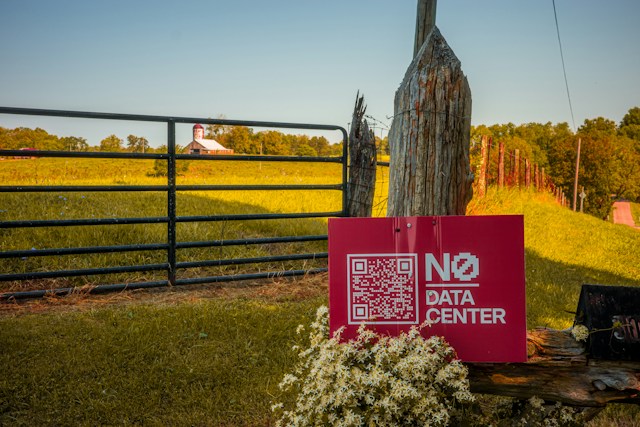
Across Pennsylvania, public discussions about large-scale data centers have increasingly focused on where these facilities are built, how much land they consume and how their presence could change surrounding communities. State legislative hearings have specifically examined agricultural production, farmland preservation, land use, siting and the challenges rural municipalities face when evaluating large developments.
Farmland and open space have become a particular concern in rural areas. A large data center campus can require hundreds of acres, while associated substations, transmission lines, access roads and other infrastructure can expand the overall footprint. Farmers and agricultural advocates have raised concerns that the growth of AI infrastructure could put additional pressure on productive farmland and create conflicts with long-term land preservation.
The potential effect on wildlife, forests and natural areas is another issue. Clearing large areas for buildings, roads and utility infrastructure can alter habitat and fragment wooded areas. In Archbald, community discussions surrounding the proposed Wildcat Ridge data center have included questions about forest clearing, wildlife and the broader environmental effects of the development. Developers have also been required in individual projects to evaluate potential effects on plants and animals and address habitat concerns through the permitting process.
Noise is a Major Concern for Local Communities
Data centers operate around the clock, and cooling equipment, mechanical systems, electrical equipment and backup generators can produce continuous sound. Residents in several Pennsylvania communities have raised concerns about the effect of that noise on nearby homes and the character of previously quiet neighborhoods. In Archbald, sound has become a significant issue in the local review of the Wildcat Ridge proposal, while residents in other communities have questioned how noise would be measured and controlled over the long term.
Lighting and the visual impact of large industrial campuses are also part of the discussion. Large buildings, security lighting, parking areas, substations and other infrastructure can substantially change the appearance of rural or semi-rural properties, particularly when facilities are built close to homes. A South Strabane Township proposal prompted discussion of setbacks as well as requirements for controlling noise and light. In Archbald, lighting has also been addressed through local land-development requirements.
The Cumulative Effect of Multiple Projects
A community may not be dealing with one building in isolation. Several proposed facilities can require new roads, utility infrastructure, substations and transmission lines, potentially changing traffic patterns, viewsheds, property surroundings and the character of an area. Residents in many Pennsylvania communities have raised questions about what happens when multiple data centers are proposed within the same region and how local governments should evaluate their combined effects.
Pennsylvania’s current GRID requirements specifically call for developers to provide information about a project’s acreage, peak electricity demand, annual water consumption, water source and environmental protections. The requirements also call for community-benefit agreements that can address traffic, noise, lighting, air quality, emergency management and aesthetic concerns.
For critics, that is the central issue with addressing data centers solely through utility costs. Paying for new electricity infrastructure does not necessarily answer questions about farmland, wildlife habitat, noise, light pollution, water use, traffic, local zoning or the long-term character of a community. Those issues are largely tied to land-use decisions and the specific design and location of individual projects.
Josh Shapiro’s Executive Order
In August 2026, Gov. Josh Shapiro’s Executive Order 2026-05 directed state agencies to require data center proposals seeking state permitting to meet GRID requirements and receive required local approvals. The requirements include community engagement, environmental protections, water conservation and information about the project’s physical and resource demands. The order also removed data centers from the state’s permit fast-track program.
Still, the debate illustrates why data center development has become a land-use and community-planning issue as much as an energy issue. For communities considering these projects, the questions extend beyond who pays for the electricity infrastructure to where facilities should be located, how much land they should occupy, what protections should surround neighboring homes and natural resources, and how residents can participate in decisions that could permanently change the area.
A Broader Debate
Expanding the grid can benefit an entire region by adding generation and improving transmission capacity, but some investments may be necessary primarily because of a particular large customer.
The Ratepayer Protection Act attempts to draw a clearer financial line between those situations. Its approach is based on the principle that infrastructure costs attributable to a large new electricity customer should not automatically be spread across existing customers.
The legislation’s sponsors argue that this approach can allow data center development to continue while reducing the possibility that households and small businesses will be charged for upgrades primarily needed by large technology companies.

What Happens Next?
The immediate question is whether the Senate will take up the legislation.
The House has completed its action on H.R. 9340, but the bill is not law. If the Senate approves the legislation in the same form, it could proceed to the president. Any changes made by the Senate would create additional steps before the measure could take effect.
For state utility regulators, the more significant changes would come later. If the bill becomes law, regulators would have to examine how large-load customers are charged for the incremental infrastructure required to serve them.
That could become increasingly relevant as utilities plan for electricity demand associated with artificial intelligence, cloud computing and other large-scale digital infrastructure. Data centers can bring investment, construction activity and additional demand for local services, but at the same time, communities and utilities must consider electricity capacity, transmission requirements and other infrastructure needs.
For consumers, the key point is that the House vote represents a proposed change in who bears the cost of accommodating large new electricity users, rather than an immediate change to household utility bills.